Quick reference
The standard weekly calls at a glance. Section 26 explains the Fall Cup and Turkey Bowl snap exception.
- Players
- Usually 5v5, 6v6, or 7v7
- Field length
- 60 yards goal line to goal line + two 10-yard end zones
- 5v5–6v6 width
- One sideline to the opposite hash, about 35.5 yards
- 7v7 width
- Full football-field width
- Normal possession starts
- Own 5-yard line
- First down
- 4 downs to cross midfield
- After midfield
- 4 new downs to score
- QB run
- QB cannot cross the LOS as a runner
- Rush
- Immediate QB rushers start 5 yards back; closer defenders may cover screens and runs
- No-run zones
- Final 5 yards before midfield and goal line
- Game clock
- None
- Play clock
- None
- Timeouts
- None
- Winner
- First team to 30 or more points
- Mercy rule
- Game ends immediately at a 25+ point lead
- Touchdown
- 6 points
- PAT
- 1 from the 5; 2 from the 12
- Safety
- 0 points; loss of down
- Bad snaps (weekly)
- Unlimited free retries for accidental snap exchanges
- Weekly kicking
- None
- Thunder or lightning
- Stop play; shelter; wait 30 minutes after the last occurrence
- Fall Cup and Turkey Bowl bad snaps
- One free retry per possession; later bad snaps cost the down (Section 26)
No rules match that search. Try another term.
The game
01The Field
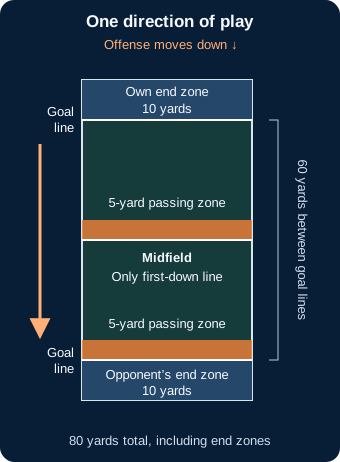
The playing field is 60 yards from goal line to goal line, with a 10-yard end zone on each end, for an 80-yard total field.
5v5 and 6v6
The field runs from one sideline to the opposite-side hash, approximately 35.5 yards wide.
7v7
The full width of the football field is used.
Midfield is the only first-down line.
02How a Game Works
Normal SCFC games have:
- No game clock
- No play clock
- No timeouts
Halftime is informal. The group can take a break around the middle of the game when it makes sense.
The first team to reach 30 or more points wins.
Mercy Rule
The game also ends immediately whenever one team leads by more than 24 points.
In other words, a 25-point or larger lead ends the game.
Examples:
- 24–0: keep playing
- 25–0: game over
- 31–6: game over
03Possessions & Downs
A normal possession starts at the offense's own 5-yard line.
The offense gets:
4 downs to cross midfield.
Once the football crosses midfield, the offense receives:
4 new downs to score.
The football itself must break the plane of midfield to earn the first down.
There are only two targets during a possession: midfield, then the goal line. An automatic first down awarded while the ball is still before midfield resets the offense to four downs to reach midfield.
Crossing midfield then earns four downs to score. Once the offense has earned that scoring series, its target remains the goal line for the rest of the possession, even if a later play loses yards back across midfield.
Crossing midfield again does not award another first down. A defensive penalty that awards new downs may reset the scoring series under Section 22; losing yards by itself never does.
The football must break the plane of the goal line for a touchdown.
Fourth Down Before Midfield
The offense has two choices.
Go for it
Run the fourth-down play.
If the offense fails to cross midfield, the opponent takes possession where the play ends.
Change possession
The offense may elect not to run the fourth-down play.
The opponent then starts at its own 5-yard line.
This functions like a simplified punt. There is no actual punt.
Fourth Down After Midfield
After crossing midfield, there is no change-possession option.
If the offense fails to score on fourth down, the opponent starts at its own 5-yard line.
Offense
04Formation
The center must be on the line of scrimmage (LOS).
Everyone else may line up:
- On the LOS, or
- Behind the LOS
There is no NFL-style covered-receiver rule. A receiver does not become ineligible simply because another player is lined up outside of them.
Every offensive player is eligible, including the center. The center may release into a route after the snap or stay to block. Another offensive player may line up to block for the quarterback; playing center does not require staying in to block.
Before the snap, everyone must be set for at least one second, except for one player who may be in motion.
Only one offensive player may be in motion when the ball is snapped.
05The Snap
The football must be snapped between the center's legs.
A direct snap may go to any player who is not lined up on the LOS.
Bad Snaps — Weekly Games
An accidental failure of the snap exchange between the center and the intended receiver of the snap is a bad snap if the receiver has not yet controlled the football. Blow the play dead immediately. Neither team may advance or recover it.
Replay the same down from the original LOS, with no yardage penalty or loss of down. Weekly games allow unlimited free bad-snap retries so any player can try center without costing the team a down. The snap must still travel between the center's legs; a short, gentle snap to a receiver lined up close is legal.
Once the receiver controls the snap, the play is live. A later fumble, dropped handoff, or incomplete pass is not a bad snap and follows the normal rules.
The Fall Cup and Turkey Bowl use the event rule in Section 26.
06Quarterback Rules
The player who initially receives the snap is the quarterback.
The QB may move anywhere behind the LOS but may not cross the LOS as a runner.
There is no five-second passing clock or other passing countdown.
QB as a Receiver
The QB may become an eligible receiver after legally giving the football to another player behind the LOS by handoff, pitch, or backward pass.
07Passing
Only one forward pass is allowed per play.
A legal forward pass must be released while the passer is still behind the LOS.
A player who receives a handoff, pitch, or backward pass behind the LOS may subsequently throw the forward pass, provided that player is still behind the LOS.
Once the football has crossed the LOS, it cannot later be brought back behind the LOS and legally thrown forward.
08Handoffs & Laterals
Handoffs are allowed behind the LOS.
Backward passes and laterals are unlimited.
They may occur:
- Behind the LOS
- Beyond the LOS
- During a live interception return
A backward pass or lateral caught before touching the ground remains live.
Forward handoffs beyond the LOS are not allowed.
09No-Run Zones
There is a 5-yard no-run zone immediately before:
- Midfield
- The opponent's goal line
When the LOS is inside a no-run zone, the football must cross the LOS through a legal forward pass.
A handoff, lateral, screen, or other exchange behind the LOS does not by itself satisfy the no-run-zone requirement.
The eventual forward pass must cross the LOS.
Contact & catches
10Rushing the Quarterback
A defender who intends to rush the quarterback must begin at least 5 yards behind the LOS.
Any number of eligible defenders may rush.
A defender may line up at the LOS, except directly over the center, to cover a receiver, screen, or run. A defender who starts inside the 5-yard rush line may not cross the LOS to rush the player who received the snap while that player still has the ball. Once that player actually hands off, pitches, or throws a backward pass, any defender may cross the LOS to pursue the player with the ball. A fake handoff or pitch does not release defenders to rush.
Rushers must avoid forceful contact with any passer. No defender may line up directly over the center.
There is no five-second QB count.
Sacks
The quarterback is sacked when the QB's flag is pulled while the quarterback still possesses the football behind the LOS.
If the football is still in the passer's hand when the flag is pulled, the play is a sack even if the throwing motion has already begun.
11Receiving
All offensive players are eligible receivers, including the center.
The QB becomes eligible after legally giving possession to another player behind the LOS.
Completing a Catch
A catch is complete when the receiver:
- Secures possession of the football, and
- Gets at least one foot in bounds
If the receiver is falling while making the catch, the receiver must maintain possession through contact with the ground.
A simultaneous catch by an offensive and defensive player belongs to the offense.
Receiver Goes Out of Bounds
A receiver who voluntarily steps out of bounds may return to the field but may not be the first player to touch a forward pass.
If that player is first to touch the pass, it is a minor SCFC foul.
12Running, Jumping & Diving
Ball carriers may use normal evasive moves, including:
- Cuts
- Spins
- Dips
- Hops
- Jump cuts
- Safe evasive leaps
A runner may not hurdle another player.
A ball carrier may not intentionally dive, lunge, or fall forward in order to gain additional yardage or reach a first-down or goal line.
A defender may dive in an attempt to pull a flag.
13Flag Pulling
The defense plays the flag, not the runner's body.
Flag football is not tackle football.
Defenders may not:
- Tackle
- Wrap up
- Bear-hug
- Hold a runner in place
- Wrestle a runner down
- Intentionally knock a runner down
- Push a runner out of bounds instead of attempting a legal flag pull
Missing or Fallen Flags
A player who starts the play with one or both flags missing, or whose flag falls off on its own before receiving the football, may still make a legal catch. The player is down where the catch is made and cannot run after the catch.
If a ball carrier's flag falls off on its own after they have possession, the play is dead where the flag came off. Reattach or replace missing flags before the next play.
14Flag Guarding
The runner's flags must remain reasonably accessible to the defense.
The ball carrier may not prevent a flag pull by:
- Stiff-arming
- Swatting a defender's hands
- Covering or pinning a flag
- Using the football to shield a flag
- Using the hand, arm, elbow, or shoulder to deliberately prevent access to a flag
Normal running motion, spinning, cutting, and dipping remain legal unless they are being used to physically prevent the defender from reaching the flag.
15Blocking
SCFC permits controlled contact blocking.
Legal blocking uses open hands with contact generally between the opponent's shoulders and waist.
Blocking must remain controlled.
Illegal Blocking
The following are not allowed:
- Holding
- Grabbing
- Hooking or wrapping a defender
- Blocking in the back
- Crackback blocks
- Blindside blocks
- Running-start hits or charging through an opponent
- Low, cut, or chop blocks
- Tripping
- Launching into another player
- Leaving the feet to deliver a block
- Contact to the head or neck
A blindside block is contact with a defender who cannot see the blocker approaching, including from the side. A block in the back is separately illegal. Do not initiate a block if the defender cannot see it coming.
Downfield Blocking
Downfield blocking is permitted on running plays and after a pass has been completed. A downfield blocker must slow down, stay on their feet, and use controlled open hands against a defender who can see the block coming. If a safe block is not possible, the teammate may run alongside the play without initiating contact.
Offensive players may not block downfield while a forward pass is traveling through the air.
Center Protection
The center is protected while in the snapping position.
The defense may not contact the center until the center raises their head and either:
- Begins releasing into a route, or
- Assumes a blocking position
16Pass Coverage
Defenders may use controlled press or jam coverage from the LOS through approximately 5 yards downfield.
A defender may not:
- Hold
- Grab
- Trip
- Hook
- Arm-bar
- Turn a receiver by grabbing
- Ride a receiver off their route
- Otherwise materially restrict the receiver illegally
Once the football is in the air, players must play the pass without illegally restricting the opponent.
Incidental contact by itself is not automatically a foul. Players contesting a catch must not push, undercut, or crash into an airborne opponent. Clear interference must materially restrict a receiver's chance to make a catch; ordinary incidental contact is not interference.
Defensive pass interference is enforced under Section 22. Unsafe contact is a major safety foul regardless of whether a pass is caught.
Possession & points
17Fumbles & Loose Balls
There are no live loose-ball recovery scrums.
If a fumble or backward lateral hits the ground or goes out of bounds, the play is dead and the team that possessed the football keeps possession, subject to the normal down count.
If a loose ball is caught before touching the ground or going out of bounds, it remains live.
Forward Fumble
If a ball carrier loses the football forward and it hits the ground, the football is spotted where the ball carrier's feet were when possession was lost, not where the loose football eventually lands.
Bad Snap Exception
A bad or muffed snap does not use the normal fumble rule.
Apply the weekly retry rule in Section 5, or the Fall Cup and Turkey Bowl rule in Section 26.
18Interceptions
Interceptions are live and returnable.
After an interception, the return continues until the runner:
- Has their flag pulled
- Goes out of bounds
- Scores
- Or the play otherwise legally becomes dead
The new team takes possession where the interception return ends.
Interception in the Defense's Own End Zone
An interception caught in the defender's own end zone remains live and may be returned. If the return ends in that end zone without the runner bringing the ball out, it is a touchback: the intercepting team starts at its own 5-yard line. If the runner brings the ball out, use the normal end-of-return spot. A runner who brings the ball out and then retreats into their own end zone does not receive a touchback; the normal safety rule applies.
An interception returned during a PAT attempt is worth 2 points.
19Stripping the Football
Defenders may not intentionally strip or knock a football that is already possessed out of a player's hands.
This includes the quarterback.
The defender should attack the flag, not the football.
20Scoring
Touchdown
6 points
1-Point PAT
Ball placed at the 5-yard line.
The no-run-zone rule applies, so the football must cross the LOS on a legal forward pass.
2-Point PAT
Ball placed at the 12-yard line.
Run or pass is allowed.
Defensive PAT Return
A defensive interception returned to the opposite end zone is worth 2 points.
21Safeties
SCFC does not award points for a safety.
If the football becomes dead in the offense's own end zone, the offense loses the down.
If downs remain, the next play begins from the applicable spot inside the offense's own end zone.
If no downs remain, normal turnover-on-downs rules apply.
Calls & events
22Penalties
SCFC intentionally uses a simple penalty system instead of a large penalty chart.
The basic question is:
Was it negligible, did it create an unfair advantage, or did it create meaningful injury risk?
The team affected by a foul may decline the yardage and down penalty and take the result of the play. Dangerous conduct is still addressed even if its yardage penalty is declined.
Captain Conference (No Referees)
Players should raise a disputed call promptly. The captains confer briefly about what they saw and apply these rules. If they cannot agree on a material call, replay the down from the previous spot rather than prolonging the argument. The commissioner may make the final call when present. Stop play immediately for an injury or unsafe conduct.
Repeated clearly deliberate fouls or unsafe behavior are handled by the captains and commissioner. They may pause play, have a player sit out, or remove a player who continues to put others at risk. This is conduct management, not an additional penalty tier.
Defensive Pass Interference
For clear defensive pass interference on a pass outside the end zone, award the offense 5 yards and a new set of four downs toward the applicable target (midfield or the goal line). Do not attempt to estimate the spot of a hypothetical catch.
For clear defensive pass interference on a pass intended for a receiver in the opponent's end zone, place the ball at the opponent's 5-yard line and award four new downs to score. If the previous LOS was closer to the goal line than the 5, keep that spot and award four new downs. A completed play may stand if the offense declines the penalty.
These pass-interference remedies override the usual five-yards-and-replay result for a minor foul. If five yards would cross the goal line, use half the distance to the goal. Incidental contact is not pass interference. Dangerous or reckless contact is a major safety foul and must be addressed as unsafe conduct.
Super-Minor / Negligible
Examples include:
- False start
- Encroachment
- Bad snap in a weekly game (see the event exception in Section 26)
- Clearly accidental procedural mistake
- Other negligible violations with little or no effect on the play
Penalty: Redo the down.
No yardage penalty. No loss of down.
Minor Foul
A minor foul creates a meaningful unfair advantage but does not create significant safety risk.
Examples include:
- Minor holding
- Minor illegal contact
- Minor illegal blocking
- Illegal touching
- Other ordinary non-dangerous fouls
Penalty: 5 yards and replay the down.
Major / Safety Foul by the Offense
A major foul involves dangerous or reckless action where someone could reasonably have been hurt.
Examples include:
- Dangerous blocking
- Blindside or crackback contact
- Significant illegal contact
- Head or neck contact
- Other unsafe play
Penalty: 5 yards + loss of down.
Major / Safety Foul by the Defense
Examples include:
- Tackling
- Dangerous contact
- Significant illegal contact
- Dangerous blindside contact
- Head or neck contact
- Other unsafe play
Penalty: 5 yards + automatic first down.
An automatic first down gives the offense a new set of four downs toward its current target: midfield before the scoring series has been earned, or the goal line after it has been earned. If the enforced penalty spot crosses midfield, the offense enters the scoring series with four downs to score.
23Substitutions
SCFC uses rolling or hot substitutions.
Players may rotate in and out between plays as needed.
Players should tap out when tired and rotate teammates in rather than monopolizing playing time.
24Kicking
Normal weekly SCFC games have:
- No kickoffs
- No actual punts
- No field goals
The fourth-down change-of-possession option before midfield serves as SCFC's simplified alternative to punting.
25Co-Ed Play
SCFC is co-ed.
The same gameplay rules apply to everyone.
There is no required female-touch rule, operative-player rule, or different scoring system based on gender.
26Special Events
These are the standard rules for normal weekly SCFC games.
The Fall Cup, Turkey Bowl, or another announced special event may modify rules such as:
- Game length
- Clock
- Team structure
- Kicking
- Scoring
- Substitutions
- Tournament format
- Officiating
Fall Cup and Turkey Bowl Snap Rule
The Fall Cup and Turkey Bowl each allow one free bad-snap retry per possession. The first accidental bad snap before the receiver controls the football is immediately dead; replay the same down at the original LOS. Any later bad snap during that possession is immediately dead at the original LOS and the down counts, with no additional yardage penalty. Neither team may advance or recover a dead bad snap.
If the event uses a game clock, stop it on a dead bad snap and restart it on the next legal snap so a retry cannot run down the clock. The between-the-legs snap requirement and the center's receiver eligibility remain the same as in weekly games.
Turkey Bowl Center Rotation
The player at center may stay on offense when extra players require a rotation. They are not required to take a turn sitting out while playing center. They may still ask for a break or switch positions; playing center does not require staying on the field when tired or hurt. Other players continue to rotate normally, including on defense.
Other announced event-specific rules override weekly rules for that event.
27Game-Day Safety & Participation
Remove or cover jewelry and hard or exposed gear that could injure another player. Do not play with exposed metal, hard casts, or other hazardous equipment. Captains may ask a player to change or remove unsafe gear before returning.
Stop play immediately for an injury. Give the injured player room and do not resume until they are safely off the field or ready to continue.
At any thunder or lightning, stop play and clear the field for safe shelter; do not shelter under a tree. Resume only after 30 minutes without further thunder or lightning, and only if conditions are safe. Each new thunderclap or lightning sighting restarts the 30-minute wait.
Use rolling substitutions to give teammates meaningful offensive and defensive opportunities. Captains should help rotate players in, including newcomers and players who want to try a different position.